Finding the right bedside table nz options means understanding more than style. A bedside table holds your phone, book, reading lamp and alarm clock within arm's reach, all while fitting the floor space next to your bed. The height needs to align with your mattress top, the depth can't block your bedside path, and the drawer or shelf arrangement determines whether it stays tidy or becomes a catch-all. In New Zealand bedrooms, where floor plans vary from compact townhouses to sprawling master suites, the bedside table becomes a functional anchor that defines how comfortably you start and end each day. This guide covers materials, dimensions, construction and pairing strategies for selecting a bedside table that works in real rooms, not just mood boards.
Material and Construction Standards for Bedside Tables
Bedside tables in New Zealand are built from solid timber, engineered timber, metal and composite materials, each with different durability, weight and maintenance profiles.
Solid Timber Bedside Tables
Solid timber offers longevity and a natural grain pattern that ages with character. Oak, ash, walnut and rimu appear in local and imported furniture collections, milled to consistent thickness and joined with mortise-and-tenon or dowel joinery. Solid timber expands and contracts with humidity shifts, so kiln-dried stock and climate-stable finishes reduce the risk of warping. A solid timber bedside table typically weighs 10 to 20 kilograms, stable enough that the drawer won't tip the unit when pulled fully open.
FSC-certified timber sourced under the New Zealand Forest Stewardship Standard ensures the wood comes from responsibly managed forests. If sustainability matters to your build or renovation, look for FSC or PEFC chain-of-custody certification on the manufacturer's spec sheet. NZGBC's Homestar eco-label guidance accepts these schemes for furniture, fittings and flooring credits, useful for developers targeting a Green Star or Homestar rating.
Engineered Timber and Veneer
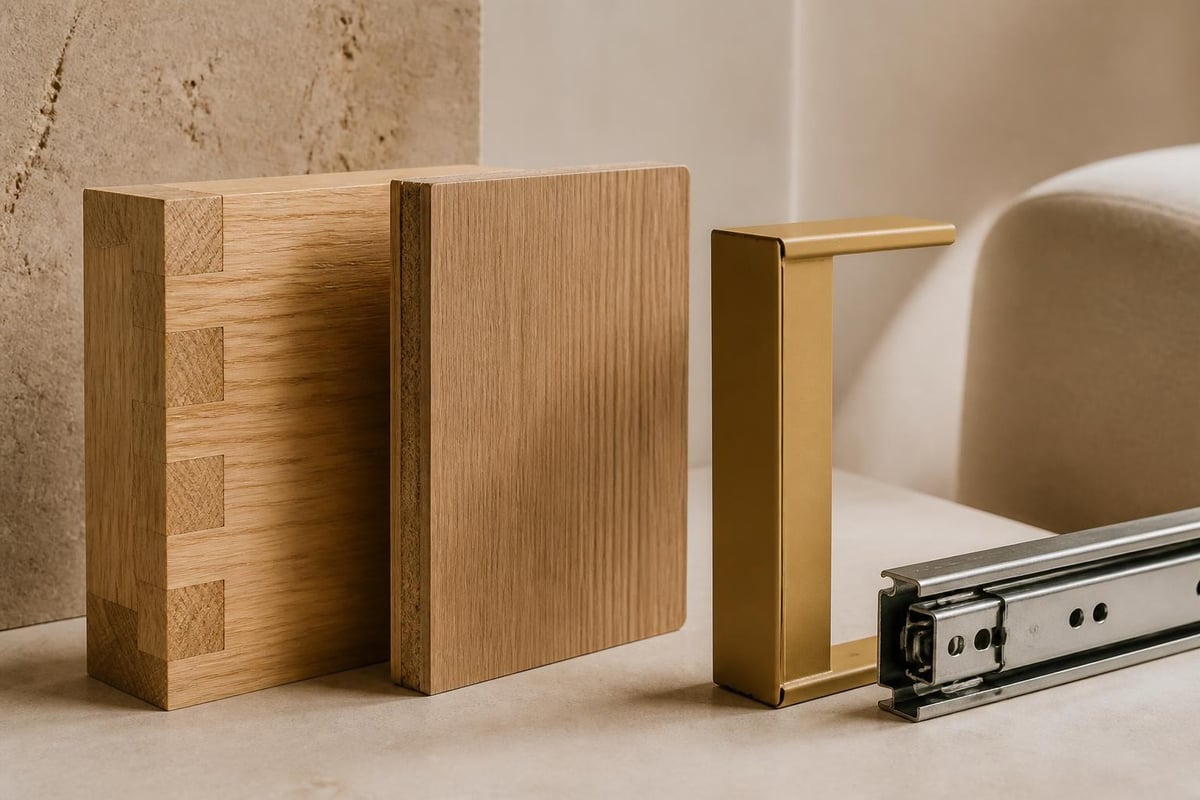
Engineered timber uses plywood or MDF cores faced with timber veneer, solid edge banding and lacquer or UV-cured finishes. The core stays dimensionally stable, the veneer delivers the timber look, and the overall weight drops by 20 to 30 percent compared to solid construction. Edge banding needs to wrap all exposed edges to seal moisture out and keep the veneer adhered over years of use.
Metal and Mixed-Material Designs
Steel or aluminium frames support timber or glass tops, common in industrial or mid-century-inspired bedside table nz collections. Powder-coated finishes resist chipping better than wet paint, and welded joints outlast mechanical fasteners. Mixed-material bedside tables suit contemporary bedrooms where a lighter visual mass keeps the room open, particularly useful when the bed frame or headboard already carries substantial weight.
Height, Depth and Drawer Dimensions
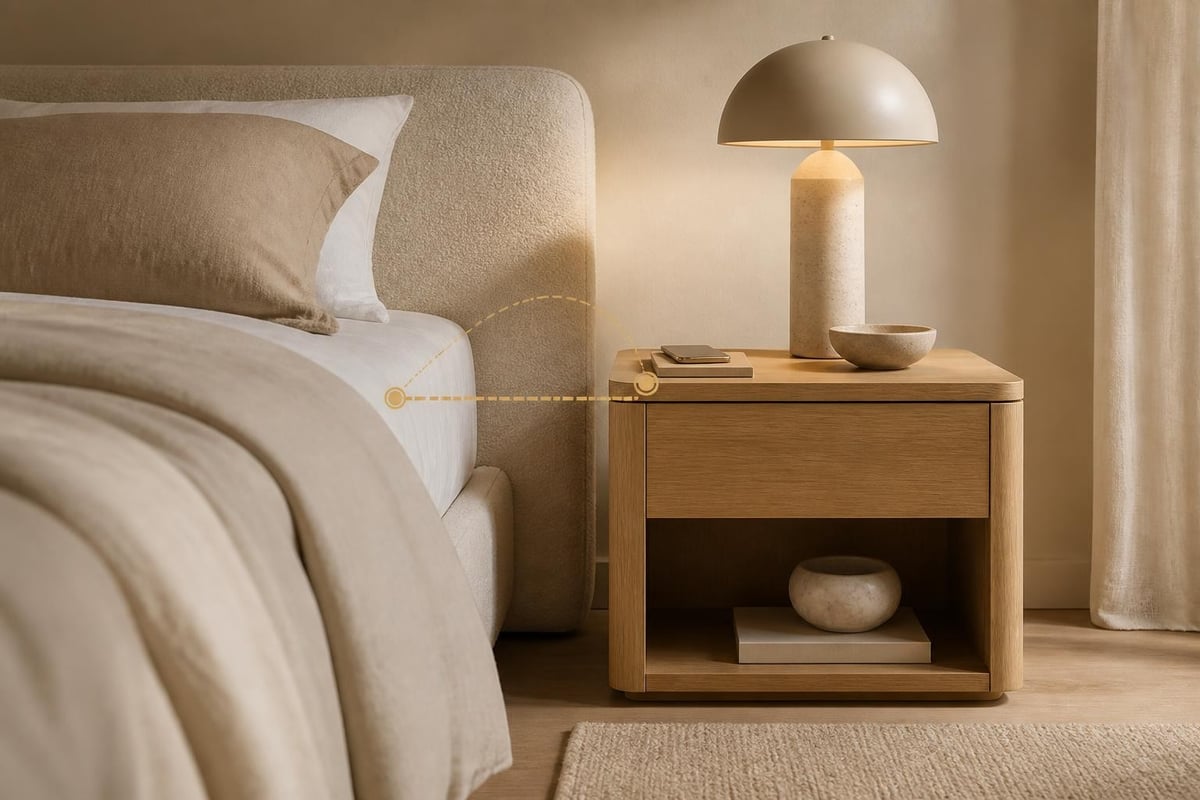
The bedside table height should align with or sit slightly below your mattress top, placing the table surface within easy reach when you're lying down. A standard New Zealand mattress sits 55 to 65 centimetres from the floor (base plus mattress), so a bedside table between 50 and 60 centimetres tall works for most beds. Adjustable beds or taller European mattress-and-base combinations may require a 65 to 70-centimetre bedside table.
| Mattress height (floor to top) | Recommended bedside table height | Clearance for reach |
|---|---|---|
| 50–55 cm | 45–55 cm | Level or 5 cm below |
| 56–65 cm (most NZ beds) | 50–60 cm | Level or 5 cm below |
| 66–75 cm (tall bases, Euro) | 60–70 cm | Level or 5 cm below |
Depth determines how far the bedside table projects from the wall. A shallow table (30 to 35 centimetres) keeps the floor path clear, useful in tight bedrooms or where the door swings close to the bed. A deeper table (40 to 50 centimetres) offers more surface area for a lamp base, book stack and decorative objects, but eats into circulation space. NZS 4121:2001 (Accessible Accommodation) recommends a minimum 900-millimetre clearance alongside beds in accessible dwellings; in practice, most bedrooms need at least 600 millimetres for comfortable passage, so depth plus clearance should not exceed the available wall-to-bed gap.
Drawer and Shelf Configuration
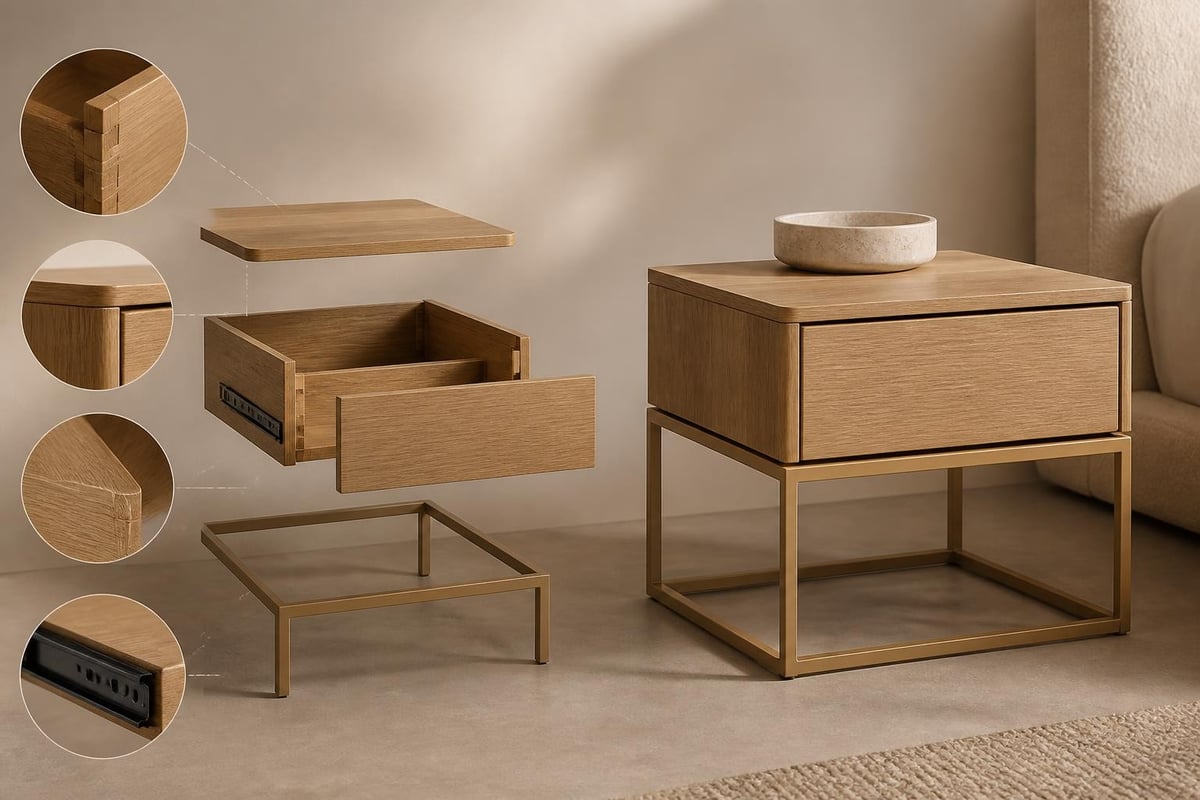
Single-drawer bedside tables place all the closed storage in one compartment, sized roughly 30 to 40 centimetres wide and 10 to 15 centimetres tall. The drawer should run on full-extension ball-bearing slides rated for 10 to 15 kilograms, so you can access items at the back without the drawer binding. Soft-close mechanisms dampen the final centimetre of travel, reducing noise and wear on the drawer box.
Two-drawer units stack a shallow top drawer (for glasses, phone, charger) over a deeper bottom drawer (for books, spare bedding). Open-shelf bedside tables skip the drawer entirely, offering quicker access but no dust protection or visual tidiness. Shelf models work well in guest rooms or minimalist bedrooms where you keep only a lamp and alarm clock beside the bed.
Styling and Pairing with Bedroom Furniture
Bedside tables sit alongside the bed, visually balancing the bed frame and headboard. When the bed frame is timber, matching the bedside table timber species and finish creates a cohesive suite. Contrasting materials add visual interest without losing coherence: a black-stained ash bed frame pairs with a lighter oak bedside table, the tone shift defining each piece while the timber grain ties them together.
Proportion and Scale
The bedside table width should relate to the bed size. A king or super-king bed (180 to 200 centimetres wide) can take bedside tables up to 60 centimetres wide without looking undersized. A double or queen bed (150 to 160 centimetres) balances better with 45 to 55-centimetre-wide tables. Single beds need compact tables, 35 to 45 centimetres, to avoid overwhelming the bed visually.
Leg height and base design influence how grounded or floating the bedside table appears. Low legs or a plinth base give a heavier, more anchored look; tall legs (15 centimetres or more) lift the table visually and physically, making floor cleaning easier and the room feel lighter. This same principle applies across living and dining room furniture, where leg height and sight lines shape how a room breathes.
Lamp and Surface Coordination
The table surface needs enough area for a lamp base (typically 15 to 20 centimetres diameter or square), plus a phone, book and water glass. Allow 10 centimetres clearance between the lamp base and the table edge to prevent tipping. Task lighting for reading should position the bulb 45 to 60 centimetres above the mattress surface, so a 50-centimetre-tall bedside table paired with a 30-centimetre lamp height places the bulb at 80 centimetres, slightly high for bed reading. A 20-centimetre lamp or an adjustable arm brings the light source closer to ideal.
Bedroom Layouts and Accessibility Considerations
Bedside table placement follows the bed position. In a standard bedroom, the bed sits against one wall or centred on the longest wall, with bedside tables flanking both sides if space allows. When only one bedside table fits, place it on the side you exit the bed, keeping phone, charger and alarm clock within reach as you wake.
Lifemark Design Standards recommend bedside table heights between 400 and 600 millimetres in universal-design homes, aligning with wheelchair transfer heights and seated reach ranges. Round or chamfered table edges reduce injury risk for people with reduced mobility or vision, and drawers with easy-pull handles or touch-latch mechanisms remove the fine-motor demand of small knobs.
Floor Clearances and Circulation
A bedside table with visible legs or a recessed plinth allows robot vacuums and standard vacuum heads underneath, reducing dust accumulation. Solid-to-floor designs require manual cleaning around the base perimeter. If your bedroom cleaning routine includes frequent vacuuming or mopping, choose a bedside table with at least 10 centimetres of clearance beneath.
Circulation around the bed should leave 600 millimetres minimum on the bedside-table side, 900 millimetres if wheelchair access matters. Measure your bedroom floor plan before selecting a bedside table depth; a 50-centimetre-deep table in a narrow room may force you to turn sideways every time you walk past the bed.
New Zealand Trends and Design Influences
Recent Resene Habitat Magazine interior features show a shift toward natural timber tones, curved edges and minimal hardware in New Zealand bedrooms. Bedside table nz collections reflect this with oak and walnut veneers, soft-close drawers and handleless push-latch fronts. Curved drawer fronts and rounded table edges appear more frequently, aligning with broader design moves away from hard angles.
Māori design influences occasionally surface in locally made bedside tables through carved drawer fronts, pounamu-inspired inlays or native timber selection. A Journal of New Zealand Studies article on local design history traces how indigenous materials and forms have shaped furniture aesthetics in Aotearoa, though contemporary bedside tables lean more toward clean Scandinavian or mid-century lines than overt cultural references.
Sustainable Materials and Local Manufacturing
Demand for low-VOC finishes, recycled content and certified timber has grown among homeowners targeting Homestar or Green Star ratings. Water-based lacquers and UV-cured topcoats emit fewer volatile organic compounds than traditional solvent finishes, improving indoor air quality in bedrooms. FSC furniture guidance for Australia and New Zealand outlines how specifiers can verify chain-of-custody documentation, useful when selecting bedside tables for multi-unit developments or commercial accommodation.
Locally manufactured bedside tables reduce shipping emissions and support New Zealand craftspeople, though imported collections from Australia, Southeast Asia and Europe still dominate mid-to-high-end retail. Check the country of origin and warranty terms; New Zealand-made furniture typically includes local after-sales support and easier access to replacement parts.
Drawer Slides, Joinery and Longevity
The drawer slide system determines how smoothly the drawer opens and how long it lasts under daily use. Undermount ball-bearing slides hide beneath the drawer box, keeping the mechanism invisible and allowing the drawer sides to sit flush inside the cabinet. Side-mount slides attach to the drawer sides and cabinet walls, visible when the drawer opens but easier to service or replace.
Full-extension slides let the drawer pull completely out of the cabinet, giving access to items at the back. Soft-close dampers slow the final few centimetres of closing travel, reducing slam noise and stress on the drawer box joints. Slides rated for 15 to 20 kilograms handle typical bedside contents (books, electronics, clothing) without sagging.
Drawer Box Construction
Dovetail or finger joints at the drawer corners outlast butt joints secured with staples or nails. Solid timber drawer boxes hold screws better than particleboard, important if you need to reattach a slide or hinge years later. A 12-millimetre plywood or solid timber drawer bottom, housed in a routed groove, resists sagging better than a thin hardboard panel nailed to the bottom edge.
The drawer front can be an applied face (attached to a separate drawer box) or a true one-piece construction where the front, sides and back form a single assembly. Applied fronts allow precise alignment and easier replacement if the finish chips; one-piece construction is structurally simpler but harder to adjust.
Bedside Table Materials in Practice
When specifying or purchasing a bedside table nz option, match the material to the bedroom's use intensity and aesthetic goals.
- Solid oak or ash: High durability, natural grain variation, heavier weight, higher cost. Suits master bedrooms and long-term residential use.
- Walnut veneer over plywood: Mid-range cost, stable construction, lighter weight, consistent grain. Works for guest rooms, developments and design-forward bedrooms.
- Powder-coated steel and glass: Modern aesthetic, easy to clean, cooler to touch, lower cost. Fits contemporary minimalist bedrooms, rental properties.
- Painted MDF: Budget-friendly, smooth finish, less durable than timber, prone to edge chipping. Suitable for children's rooms, short-term furnishing.
Finish durability matters in bedrooms where you place drinks, cosmetics or electronics on the bedside surface. Water-based polyurethane and UV-cured lacquers resist water rings and scratches better than wax or oil finishes, though they lack the soft patina that develops on oiled timber.
Integration with Bed Frames and Headboards
Bedside tables often ship separately from bed frames, but visual and functional coordination improves the bedroom's usability. When the bed frame includes integrated side tables or floating shelves, a freestanding bedside table becomes redundant unless you need extra drawer storage. Low-profile platform beds pair well with shorter bedside tables (40 to 50 centimetres tall), keeping the horizontal lines consistent.
Upholstered headboards add softness and sound absorption; pairing them with timber or metal bedside tables introduces material contrast without clashing. At Bauhaus, our collections balance different materials across living, dining and bedroom pieces, so a timber dining table can share a home with a steel-framed occasional chair and an upholstered bed, unified by proportion and finish tone rather than identical materials.
Bedside tables with open shelving or lower compartments suit bedrooms where you store extra blankets, magazines or personal items close to the bed. Closed-drawer designs keep clutter hidden, useful in smaller bedrooms or where visual calm matters. The choice depends on how much you keep beside the bed and whether you prefer quick access or a tidy appearance.
Real-World Bedroom Dimensions and Furniture Fit
New Zealand bedroom sizes vary from compact 2.4 × 3.0-metre secondary bedrooms to generous 4.0 × 5.0-metre master suites. In a tight room, a single bedside table on the exit side of the bed may be the only option. In larger rooms, matching tables on both sides balance the bed visually and give each occupant equal access to storage and lighting.
Measure your bedroom before selecting bedside table dimensions. A king bed (200 × 200 centimetres) in a 3.5 × 4.0-metre room leaves roughly 75 centimetres on each side after accounting for wall clearances. A 50-centimetre-deep bedside table fits, leaving 25 centimetres for passage. Add a 45-centimetre-wide table, and you have a workable layout. Swap the bed to a super-king (200 × 210 centimetres or wider), and the side clearance shrinks; a 40-centimetre-deep table becomes the safer choice.
Homes & Gardens' evidence-based bedroom design advice links bedside table placement and lighting to sleep quality, noting that task lighting positioned too high or too close to the pillow can delay sleep onset. Positioning the bedside table so the lamp sits 50 to 70 centimetres from your eyes when lying down, with a shade that directs light downward, reduces glare and supports wind-down routines.
Coordinating Bedside Tables with Other Occasional Furniture
Bedside tables share functional DNA with occasional tables, side tables and console tables used in living areas. The same construction principles apply: stable joinery, appropriate drawer slides, finishes that tolerate daily use. If your home uses a consistent material palette, a walnut bedside table in the bedroom can echo a walnut console in the hallway or a walnut dining table in the dining room, tying the spaces together without strict matching.
Occasional chairs or reading nooks in larger bedrooms sometimes pair with a small side table instead of a traditional bedside table. A side table with a lower shelf holds books and a reading lamp, functioning as a bedside surface when positioned next to a chair. This flexibility suits multi-purpose bedrooms or guest rooms where the furniture arrangement shifts depending on use.
Maintenance and Care for Bedside Tables
Timber bedside tables need dusting and occasional conditioning to maintain the finish. Water-based finishes wipe clean with a damp cloth; oil finishes require reapplication every 12 to 24 months to prevent drying and cracking. Avoid placing wet glasses directly on timber surfaces unless the finish is fully sealed polyurethane or lacquer.
Metal bedside tables resist moisture better but show fingerprints and smudges. Powder-coated steel wipes clean with glass cleaner or diluted detergent. Scratches in powder coat expose the base metal, leading to rust if left untreated; touch-up paint or clear nail polish seals minor chips.
Drawer slides benefit from occasional lubrication, especially in coastal areas where salt air accelerates corrosion. A silicone-based lubricant on the ball-bearing track keeps the drawer running smoothly. Check the drawer box joints annually; if a corner feels loose, a drop of wood glue and an overnight clamp restores the bond before the joint fails completely.
More detailed care guidance across different furniture types and finishes is available in the furniture care guide, covering upholstery, timber, metal and composite materials.
Storage Alternatives and Bedside Table Variants
Not every bedroom suits a traditional bedside table. Wall-mounted floating shelves eliminate floor space, useful in compact rooms or minimalist interiors. A floating shelf with a single drawer, mounted at 50 to 60 centimetres above the floor, functions identically to a freestanding bedside table but leaves the floor clear for cleaning.
Bedside caddies or pockets attach to the bed frame or mattress edge, holding phones, remotes and books without requiring floor space. These suit temporary setups, rental properties or bedrooms where a full table won't fit. Structural stability is lower than a freestanding table, and weight capacity maxes out around 2 to 3 kilograms.
Tall narrow cabinets (30 centimetres wide, 100 centimetres tall) provide vertical storage in tight bedrooms, with drawers or shelves stacked to use height instead of floor area. The narrow footprint fits between the bed and the wall, though reaching the top shelf from bed becomes impractical for daily items.
Bedside Table Selection Checklist
When evaluating bedside table nz options, review these functional and aesthetic criteria:
- Height alignment: Table surface at or slightly below mattress top.
- Depth fit: Total depth plus clearance leaves 60 cm minimum passage.
- Drawer slides: Full-extension ball-bearing, soft-close preferred.
- Joinery quality: Dovetail or finger joints, solid drawer box, edge-banded veneer.
- Finish durability: Water-based poly or UV lacquer for wet-item resistance.
- Material match: Timber species, metal finish or veneer coordinating with bed frame.
- Surface area: Room for lamp base, phone, book, glass without crowding.
- Weight capacity: Shelf and drawer rated for expected load (10–15 kg typical).
- Assembly and delivery: Flat-pack or pre-assembled, access through doorways and stairs.
- Warranty and origin: Local manufacturing, New Zealand warranty support, FSC certification if sustainability matters.
How Bedside Tables Fit Broader Furniture Strategies
A bedside table is one piece in a larger bedroom and home furniture strategy. When furnishing a new build or renovation, consider whether the bedside table material and style align with your living and dining selections. Consistency in timber tone, leg design or hardware finish ties rooms together without requiring identical pieces.
Developers and interior designers often specify bedside tables in bulk for multi-unit projects, choosing durable, easily sourced models that tolerate varied occupant use. Homeowners have more flexibility to mix styles, selecting a statement bedside table in the master bedroom and simpler units in guest rooms.
Disclaimer: AI-supported images may differ from products on website.
Selecting a bedside table nz option that works long-term means matching height to your mattress, depth to your floor plan, and material to your bedroom's daily demands. Construction quality, drawer mechanisms and finish durability determine how the table performs over years of use. At Bauhaus, our curated collections include occasional furniture, dining tables and seating designed for durability and real New Zealand homes. Visit our Auckland showrooms to see materials, construction and finishes in person, and let our team help you find pieces that fit your space and how you live.