Finding the right desk for a New Zealand workspace means balancing ergonomic requirements, material longevity and the physical realities of modern work patterns. Whether furnishing a home office, commercial fit-out or developer project, understanding the technical parameters and local context around desk NZ selection ensures better outcomes for users and fewer costly replacements. This guide covers the dimensional, material and compliance considerations that matter when specifying workstations in Aotearoa.
Ergonomic Standards and New Zealand Workplace Guidance
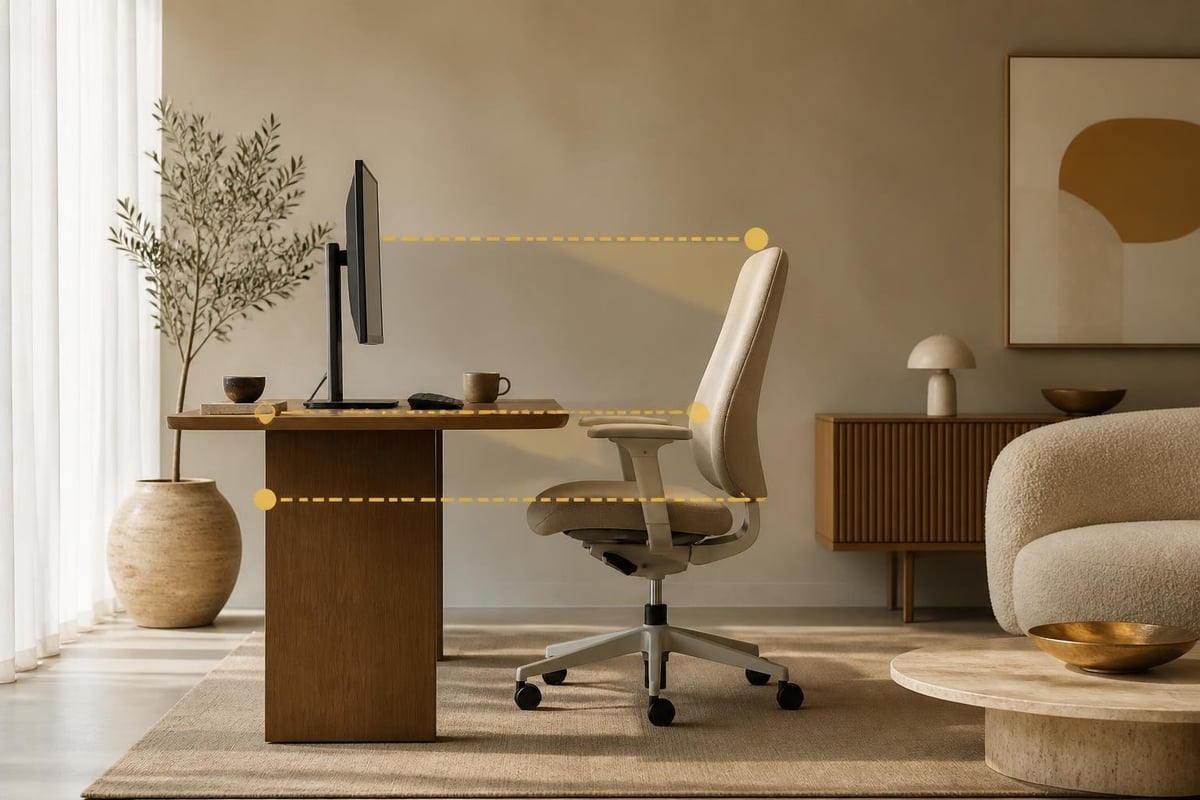
WorkSafe New Zealand provides clear guidance on setting up a healthy workstation when working from home, emphasising desk height, monitor placement and chair alignment as foundational to injury prevention. Desk surfaces should sit at elbow height when seated, typically 680–740 mm for most adults, with forearms parallel to the floor and wrists neutral during typing.
Height-Adjustable Desks vs Fixed-Height Options
Sit-stand desks allow users to alternate posture throughout the day, reducing static load on the spine and lower limbs. Research published in peer-reviewed journals demonstrates that replacing sitting with standing improves cardiometabolic markers, though the clinical significance depends on frequency and duration of transitions.
Fixed-height desks remain the most common solution in commercial and residential settings, particularly when paired with an adjustable task chair. The cost difference between electric height-adjustable mechanisms and fixed frames can be substantial, and not every user requires or prefers the complexity of motorised adjustment.
| Feature | Fixed-Height Desk | Height-Adjustable Desk |
|---|---|---|
| Typical height range | 720–740 mm | 650–1250 mm |
| Mechanism | Static frame | Electric or manual lift |
| Maintenance | Minimal | Motor, control box, annual inspection |
| Weight capacity | 50–100 kg typical | 60–80 kg typical (frame dependent) |
| Cost premium | Baseline | +40–120% |
Material Choices and Longevity in Desk NZ Construction
Desktops in commercial and residential contexts are subjected to daily abrasion, moisture, heat and impact. Material choice directly affects performance over a five- to ten-year service life.
Laminate and Melamine Surfaces
High-pressure laminate (HPL) over particleboard or MDF cores offers good scratch resistance and a broad range of finishes at moderate cost. Melamine-faced panels are less durable but widely available and suitable for light-duty home office use. Both require sealed edges to prevent moisture ingress and particleboard swelling.
Edge banding in ABS or PVC protects core materials but can lift under mechanical stress or heat. Solid timber edge lipping provides superior durability and a more refined appearance, though it adds cost and weight.
Solid Timber and Engineered Wood
Solid hardwood desktops, typically blackbutt, oak or American walnut, offer unmatched tactile quality and longevity. Timber responds to humidity changes with seasonal movement, requiring adequate joinery and finishing to prevent cupping or splitting. Oiled finishes penetrate the grain and are repairable on-site; lacquered or UV-cured surfaces resist staining but show scratches more clearly.
Engineered timber panels, including cross-laminated veneers, reduce movement and material cost while retaining a natural surface. The veneer thickness determines whether the desk can be sanded and refinished after years of service.
Steel and Aluminium Frames
Powder-coated steel provides robust support with minimal deflection under load. Tubular and flat-bar steel frames suit both residential and commercial applications, with adjustable levelling feet essential on New Zealand's uneven concrete slabs and timber floor joists.
Aluminium extrusions reduce weight and suit modular systems where desks are reconfigured or relocated frequently. The lower rigidity compared to steel requires thicker wall sections or additional bracing for equivalent stiffness.
Dimensional Compliance and AS/NZS 4442:2018
The joint Australia/New Zealand standard AS/NZS 4442:2018 specifies minimum performance requirements for office desks and workstations, including load-bearing capacity, stability testing and material safety. Compliance is not legally mandated in every context, but procurement teams and workplace safety officers increasingly reference the standard when specifying furniture.
Key Requirements in the Standard
- Surface load capacity: Minimum 25 kg uniformly distributed across desktop; concentrated load of 100 kg at any point without permanent deformation.
- Stability: Desk must resist tipping under a 250 N horizontal force applied at the front edge.
- Dimensional tolerances: Height, width and depth must fall within ±3 mm of nominal specification.
- Edge radius: Exposed edges require minimum 2 mm radius to reduce injury risk.
Desks supplied into government tenders, educational institutions or larger corporate fit-outs are often required to meet AS/NZS 4442 as a baseline procurement condition. Residential buyers benefit from the same design rigour, even when compliance certification is not formally required.
Work-From-Home Trends and Desk Demand in New Zealand
The 2023 Census revealed significant shifts in working patterns across Aotearoa, with population and dwelling highlights showing increased home-based work across urban and regional centres. More recent labour force data confirms the trend: work-from-home statistics for the September 2024 quarter indicate that roughly one in four employed New Zealanders now works from home at least part of the week.
This shift drives demand for properly specified home office furniture, replacing improvised solutions such as dining tables and kitchen benches that lack ergonomic suitability for sustained computer work.
Residential Desk Integration and Interior Continuity
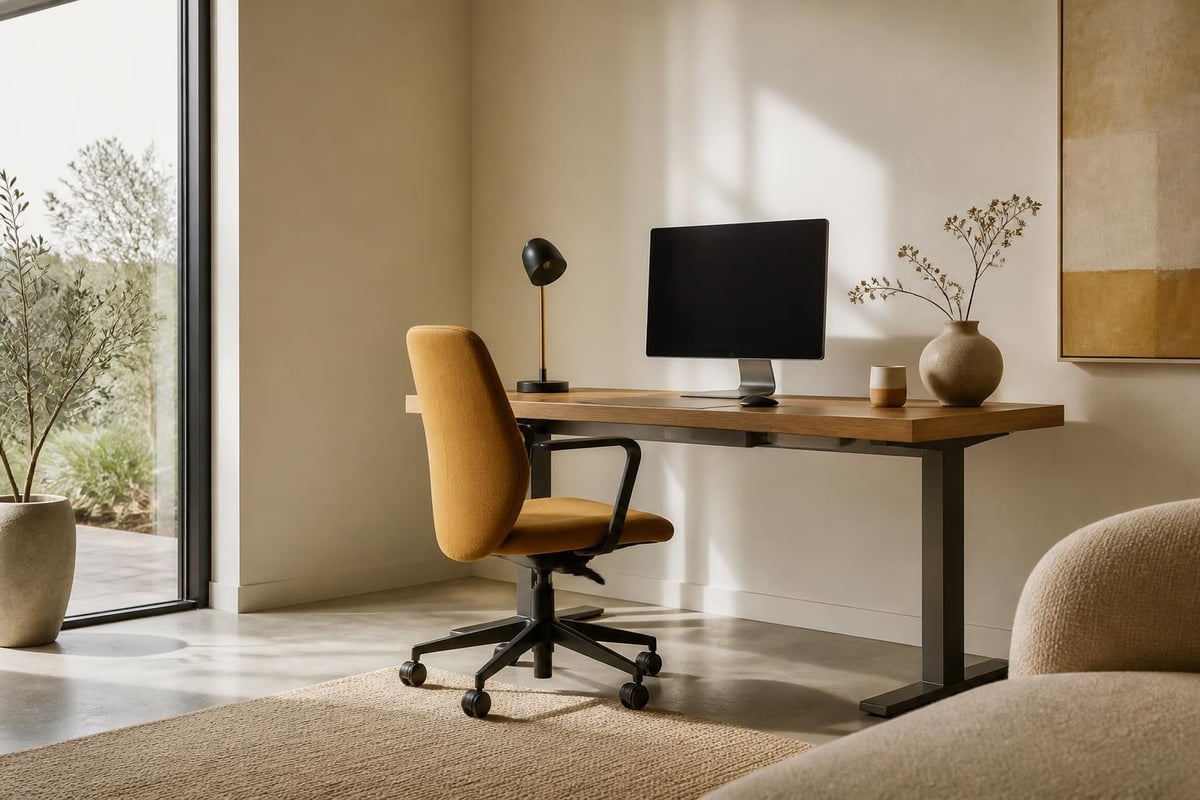
In domestic settings, the desk often occupies living or bedroom space rather than a dedicated study. Material and finish should harmonise with existing living and dining room furniture, maintaining visual coherence across the interior.
Timber desks in oiled walnut or oak pair naturally with mid-century and contemporary furniture aesthetics common in New Zealand interiors. Powder-coated steel frames in matte black or white suit minimalist schemes and allow the desktop material to anchor the palette.
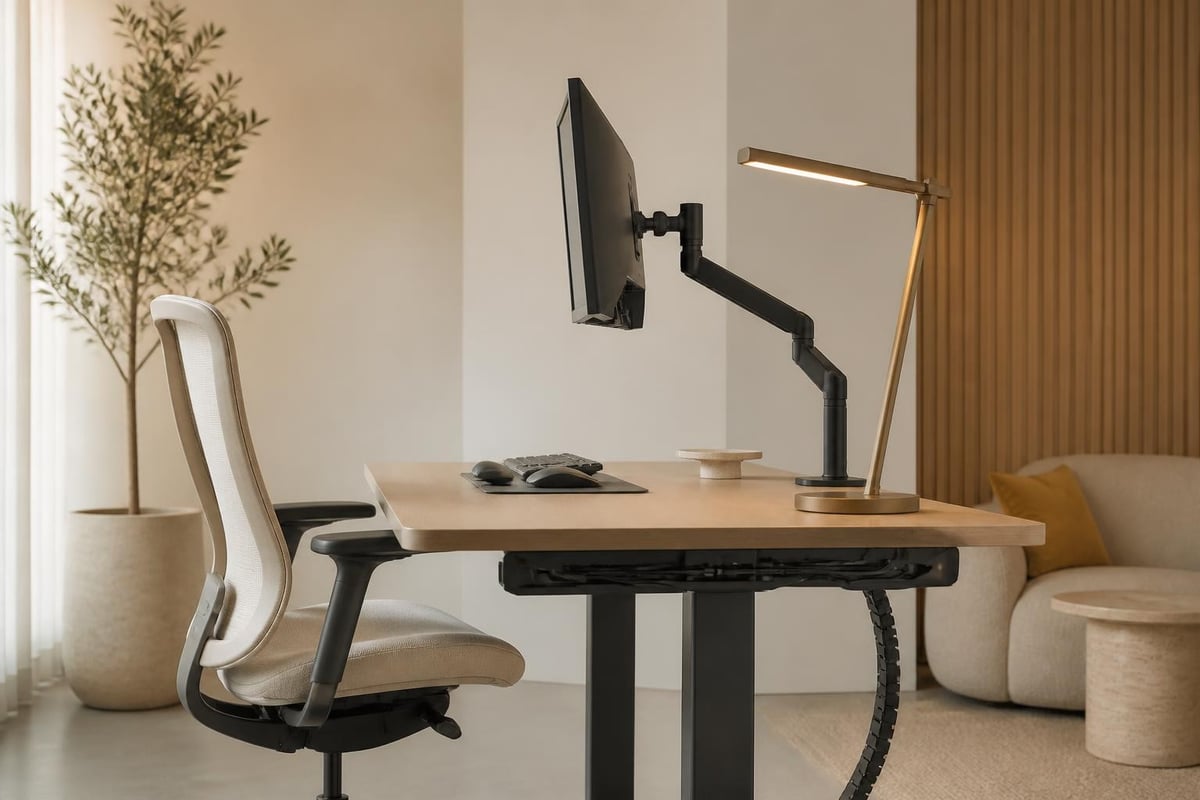
Cable management remains a practical concern. Grommets, troughs and clips keep power and data cables organised and reduce visual clutter in open-plan living areas where the desk is in constant view.
Commercial Desk Specification for Developers and Designers
Developers and interior designers specifying desks for residential developments, co-working spaces or commercial tenancies prioritise durability, lead time and ease of installation. Desks that ship flat-packed or in modular components reduce freight cost and simplify site access in multi-storey buildings.
Quantity and Lead-Time Considerations
Bulk orders typically require 8–12 weeks from confirmation to delivery when sourcing from offshore manufacturers. Local fabricators can turn around smaller quantities in 4–6 weeks but at higher unit cost. Procurement schedules should account for shipping delays, customs clearance and final assembly on-site.
Standard widths (1200, 1400, 1600, 1800 mm) allow efficient material use and reduce unit cost. Custom dimensions incur cutting and edge-banding charges that compound across large orders.
Coordinating Desks with Seating and Storage
Desks function as part of a workstation system, requiring coordinated task seating, under-desk pedestals and overhead storage. WorkSafe guidance on office worker risks emphasises the chair as the primary ergonomic control, with desk height secondary. Specifying desks without addressing chair adjustability undermines the intended ergonomic outcome.
Pedestals and storage credenzas should match desk construction, finish and hardware to maintain interior consistency. Mismatched metal finishes, timber species or laminate colours fragment the visual language and reduce the perceived quality of the fit-out.
Sustainable Material Sourcing and End-of-Life Stewardship
New Zealand's evolving product stewardship framework, outlined by the Ministry for the Environment, encourages manufacturers and retailers to take responsibility for products at end of life. While office furniture is not yet subject to mandatory schemes, voluntary initiatives are gaining traction.
Timber Certification and Low-VOC Finishes
FSC and PEFC-certified timber provides traceability and assurance that raw material originates from responsibly managed forests. New Zealand buyers increasingly request certification as part of procurement policies, particularly in public-sector and institutional projects.
Low-VOC (volatile organic compound) finishes reduce off-gassing and improve indoor air quality, a consideration in tight, well-insulated homes and offices. Water-based lacquers and plant-based oils meet stringent emissions standards without compromising surface durability.
Design for Disassembly and Material Recovery
Desks constructed with mechanical fasteners rather than adhesives can be disassembled for repair, reconfiguration or material recovery. Separating steel frames from timber tops allows each material stream to be recycled independently, improving recovery rates and reducing landfill waste.
The Building Performance guidance on materials inside homes highlights the importance of material choice and assembly methods in enabling reuse and recycling. These principles apply equally to furniture and fittings.
Desk Setup and User Customisation
Even a well-specified desk requires proper setup and adjustment to deliver ergonomic benefit. Monitor height, keyboard placement and lighting all influence posture and comfort during extended work sessions.
- Monitor distance: 500–700 mm from eyes, with the top of the screen at or slightly below eye level when seated upright.
- Keyboard position: Directly in front of user, with mouse adjacent and at the same height to avoid shoulder rotation and wrist extension.
- Task lighting: Adjustable desk lamps reduce screen glare and provide targeted illumination for document work without relying solely on overhead fixtures.
Footrests assist shorter users whose feet do not rest flat on the floor when the desk and chair are set to correct elbow height. A footrest angle of 10–15 degrees encourages ankle movement and reduces lower-limb fatigue.
Balancing Desk NZ Selection with Complementary Furniture
Workstations sit within broader interior schemes, and the desk should complement rather than dominate the room. In home offices doubling as guest rooms or reading nooks, selecting furniture that serves multiple functions reduces spatial footprint and improves flexibility.
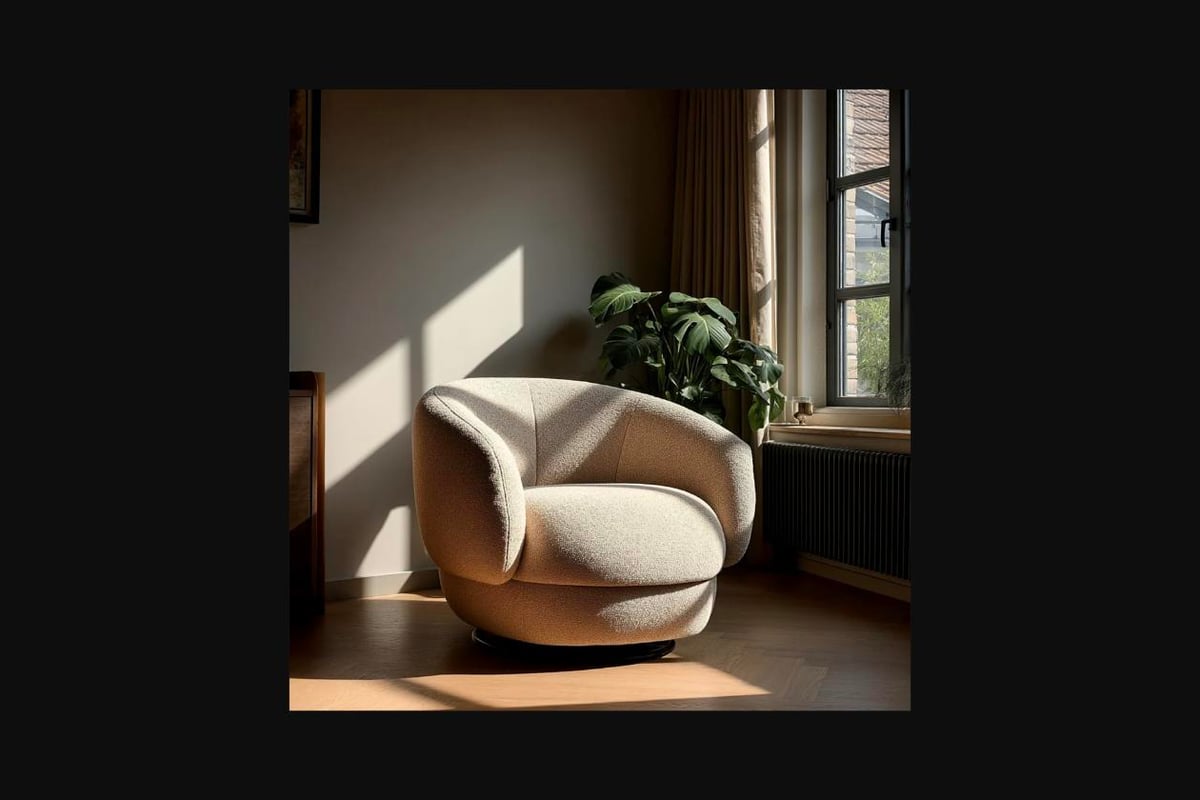
When configuring a home workspace that transitions between task focus and relaxation, consider occasional seating that supports both modes. The Cove Armchair, a barrel-backed swivel chair on a concealed 360-degree base, brings generous seating and smooth swivel action to desk areas where a fixed chair limits movement. The continuous upholstered form wraps the back into the arms, offering support for reading, video calls or angled screen work without rearranging the room layout. It suits corner placements and window spots where a traditional desk chair points one direction only.
Commercial Desk Layouts and Spatial Planning
Open-plan offices and co-working environments require careful desk arrangement to balance density, acoustic privacy and natural light access. Benching systems with shared worksurfaces maximise occupancy but reduce individual control over storage and screen orientation.
Individual desks with screens or low partitions provide visual separation without the cost and inflexibility of full-height cubicles. Partition height between 400–600 mm allows seated privacy while maintaining sightlines and natural ventilation across the floor plate.
Desk placement relative to windows should balance daylight access with glare control. Positioning desks perpendicular to glazing reduces direct screen glare while maintaining ambient light levels. Automated blinds or fixed exterior shading devices help manage solar gain without requiring manual intervention throughout the day.
Power and Data Infrastructure
Under-floor service distribution simplifies desk reconfiguration and reduces exposed cabling in commercial fit-outs. Floor boxes or pop-up sockets deliver power and data at the workstation without permanent conduit runs. Modular carpet tiles allow access to services without demolishing fixed flooring.
Surface-mounted cable trays and trunking suit retrofit projects where under-floor access is impractical. Powder-coated steel or aluminium trunking should match desk frame finishes to maintain visual consistency.
Desk NZ Considerations for Multi-Tenancy and Flexible Workspaces
Co-working operators and serviced office providers require desks that tolerate high turnover and diverse user needs. Locking mechanisms on height-adjustable desks prevent unauthorised adjustment and reduce maintenance calls. Surfaces should resist staining, scratching and heat marking from coffee cups and laptops without constant refinishing.
Shared workspaces benefit from modular desk systems that allow rapid reconfiguration to suit changing tenant requirements. Pin-and-slot or cam-lock joinery enables on-site assembly and disassembly without specialised tools, reducing relocation costs and downtime.
Maintenance and Longevity
Regular cleaning and periodic inspection extend desk service life and maintain appearance. Laminate surfaces require only damp-cloth cleaning with pH-neutral detergent. Abrasive cleaners and scouring pads damage the surface and accelerate wear.
Solid timber desks benefit from annual re-oiling or waxing to replenish surface protection and maintain colour depth. Small scratches and dents can be sanded out and refinished locally without stripping the entire top.
Steel frames require inspection of welds, fasteners and levelling feet. Loose bolts should be retightened, and damaged powder coating touched up to prevent corrosion in coastal or high-humidity environments.
Acoustic Performance in Desk-Based Environments
Hard desk surfaces and steel frames contribute little to acoustic absorption, amplifying keyboard noise and conversation in open-plan offices. Fabric acoustic panels mounted beneath desktops or as freestanding screens reduce reverberation and improve speech intelligibility.
Desk placement relative to hard floor finishes also affects acoustic comfort. Timber, polished concrete and vinyl floors reflect sound, increasing ambient noise levels. Carpet tiles or area rugs beneath workstations absorb mid- and high-frequency noise, reducing overall sound pressure.
Procurement Pathways and Supplier Selection
Specifying desks for New Zealand projects requires evaluating lead times, warranty terms and after-sales support. Offshore suppliers offer competitive pricing but longer delivery windows and limited local service networks. New Zealand manufacturers and importers with Auckland or Wellington warehousing provide faster turnaround and easier warranty claims.
Trade portals and contract pricing tiers reward volume buyers with discounts and priority access to limited stock. Designers and developers should establish accounts early in the procurement cycle to streamline ordering and track project-specific quotes.
Warranty and Support Expectations
Commercial desk warranties typically cover 5–10 years for structural defects, with consumable components such as drawer runners and levelling feet excluded. Height-adjustable mechanisms carry separate warranties, often 3–5 years on motors and control electronics.
Residential desk warranties range from 1–3 years, depending on construction quality and price point. Warranty claims require proof of purchase and evidence that failure resulted from manufacturing defect rather than misuse or normal wear.
Disclaimer: AI-supported images may differ from products on website.
Selecting the right desk NZ solution means balancing ergonomic compliance, material durability and spatial context, whether furnishing a home office or commercial fit-out. At Bauhaus, we bring the same attention to material, construction and user experience to every piece in our range, from dining tables and occasional seating to complete living room solutions. Visit our Auckland showrooms to discuss how thoughtfully designed furniture fits your project and supports the way you live and work.