A TV unit serves one purpose: it holds your screen at the right height and hides the cables. Everything else-drawer count, shelf depth, timber finish-comes second. The best tv unit nz homes choose gets specified in millimetres, not marketing copy. You need width that suits your screen, height that matches your sofa eye-line, and depth that accommodates components without overhang. Get those three measurements wrong and the unit becomes furniture you work around, not with.
Proportions That Match Your Screen and Seating
Television screens are sold in inches; New Zealand furniture dimensions are listed in millimetres. Converting accurately matters because a 65-inch screen spans 1,440 mm. Your unit should extend at least 200 mm beyond each edge to visually ground the display. A 1,800 mm wide unit works. A 1,500 mm console will look pinched.
Height depends on your sofa. Measure from floor to the centre of the seat cushion when compressed-typically 380 to 420 mm for a mid-century profile, closer to 450 mm for a deep-seat sofa like the Bowie L-Shape Sofa. Add 200 mm and you have the ideal centre point for your screen. Most freestanding units sit 400 to 500 mm tall, which positions a wall-mounted TV correctly. If you place the screen on top of the unit, add the unit height to half the screen height to check final eye level.
Depth and Overhang
Standard tv unit nz cabinets range from 400 to 500 mm deep. Screens on fixed stands need 250 to 350 mm, leaving 50 to 150 mm behind for cables and ventilation. If you wall-mount, the unit becomes pure storage. Devices stack better when shelves run 380 mm deep-enough for a gaming console, Blu-ray player and router without front overhang.
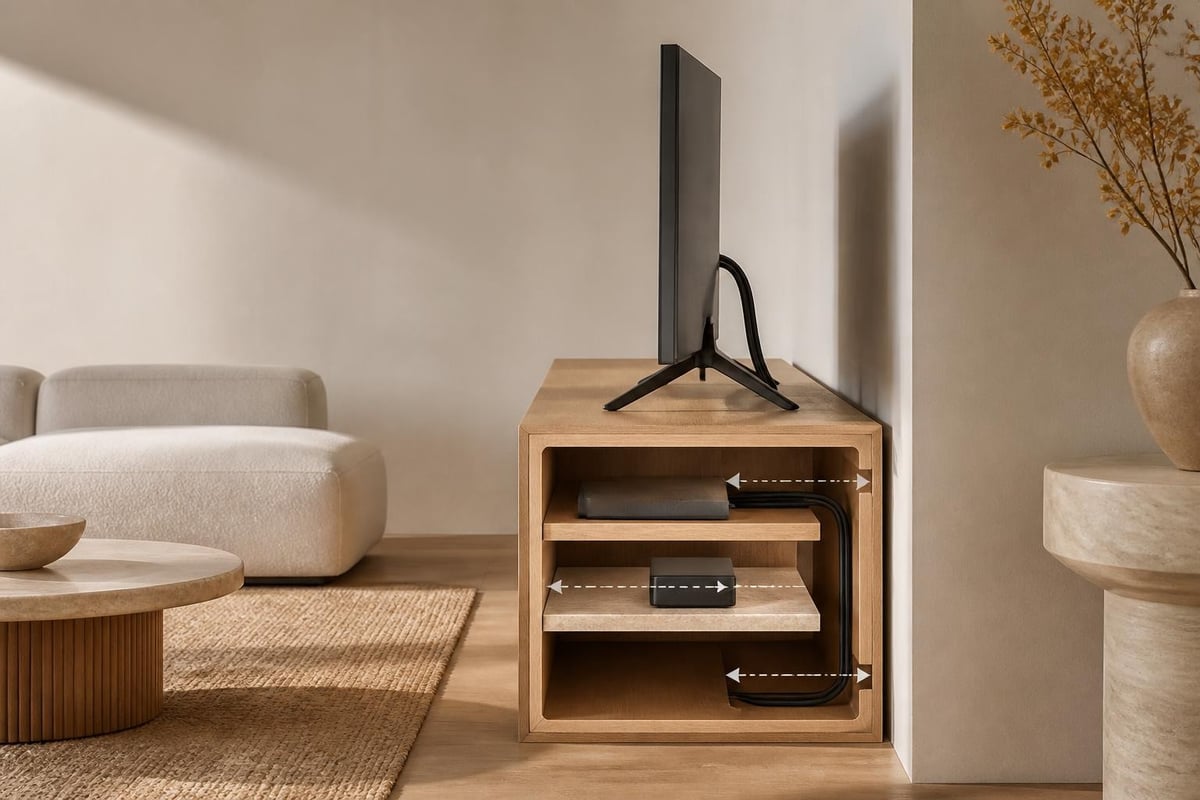
Check the screen's stand footprint before you buy. Some models use a central pedestal 280 mm deep; others span two feet set 900 mm apart. The latter forces you into a wider, deeper unit or a wall bracket.
Materials: Veneer, Solid Timber and Laminate
Oak veneer, walnut veneer and laminate each behave differently under New Zealand humidity. Veneer wraps engineered board-usually MDF or particleboard-with a sliced timber face. The substrate stays dimensionally stable; the veneer provides grain and colour. It's how most mid-to-high end units are built.
Solid timber frames and drawer boxes add weight and joinery strength, but full solid-timber TV cabinets are rare. Timber moves with seasonal moisture changes, which makes wide, unsupported panels prone to cupping. Veneer on a stable core solves that while keeping the timber look.
| Material | Durability | Moisture Response | Typical Finish |
|---|---|---|---|
| Oak veneer | High | Stable (on MDF) | Oil, lacquer, stain |
| Walnut veneer | High | Stable (on MDF) | Oil, matte lacquer |
| Laminate | Very high | Minimal | Matte, gloss |
| Solid timber | High | Moderate movement | Oil, hard wax |
Laminate resists scratches and heat better than veneer. It's the practical choice for family homes where the unit doubles as a dumping ground for remotes, tablets and coffee mugs. Matte laminate in charcoal, white or concrete grey hides fingerprints. Gloss shows every smudge.
Low-emission panels matter in closed rooms. Look for E0-rated or E1-rated MDF and particleboard, which limits formaldehyde off-gassing. EnviroSpec certifies local panel products to help specify low-VOC cabinetry for media units and built-ins across New Zealand.
Joinery and Drawer Construction
Drawer boxes built with dovetail or finger joints outlast those stapled or dowelled. Pull a drawer fully open and check the rear corner. Solid joints show interlocking timber; cheaper construction hides a glued butt joint under a veneer wrap. Soft-close runners add another $30 to $50 per drawer but eliminate the daily slam.
Cabinet carcasses use cam-lock fittings, biscuit joints or dados. Cam locks-those silver discs visible inside-allow flat-pack assembly. Biscuit joints and dados are glued during factory assembly and can't be disassembled without damage. Neither is inherently weaker if the board thickness and hardware quality match.
Cable Management and Ventilation Cuts
Every tv unit nz living rooms need should include a cable exit-either a routed hole in the back panel or an open rear frame. Without it, you're feeding HDMI, power and antenna cables over the top edge, which looks as bad as it sounds.
Pre-cut cable ports sit 100 to 150 mm from the side or rear corner. Grommet inserts (plastic or metal rings) tidy the hole and prevent veneer chipping. Some units ship with brush-style grommets that let you push cables through without unplugging connectors.
Ventilation becomes critical when you enclose components behind doors. Amplifiers, game consoles and set-top boxes generate heat. Closed cabinets without rear or side vents can push internal temps above 35°C, shortening device life. A 50 mm gap at the cabinet back or a pattern of 12 mm holes drilled into the rear panel solves it.
Electrical Considerations
Wall-mounted screens often require additional power points behind the unit. New Zealand's AS/NZS 3000 wiring standard governs socket placement and cable concealment. Installing new sockets or chasing cables into the wall is prescribed electrical work. You need a licensed electrician. The Electrical Workers Registration Board explains which standards apply and what homeowners can and cannot do themselves.
WorkSafe NZ's guidance on safe living with electricity confirms that any work inside walls, consumer mains or fixed wiring must be done by a registered professional. Running a power strip along the skirting is legal; cutting into plasterboard to hide cables is not-unless you hold the right licence.
Open Shelving Versus Closed Storage
Open shelves show your components, making access and ventilation simple. Closed cabinets hide clutter but trap dust and heat. Most units combine both: open centre bay for the soundbar and consoles, flanking cupboards for DVDs, magazines and controller charging cables.
Adjustable shelves let you reconfigure storage as devices change size. Fixed shelves save cost but lock you into the factory layout. If you own a record player, amplifier or stacked media server, adjustable pegs or cam-shelf supports give you the clearance you need.
Glass shelves suit minimalist units but show every fingerprint and cable shadow. Timber or laminate shelves blend better and support more weight. Toughened glass is rated to 20 kg per shelf; a timber shelf on metal pins handles 30 kg comfortably.
Finishes That Age Well in New Zealand Conditions
Oil and hard-wax finishes penetrate timber veneer, leaving a low-sheen surface that can be spot-repaired with fresh oil. Lacquer and polyurethane form a film on top of the veneer, providing better moisture and scratch resistance but harder repairs-you sand back and refinish the whole panel to fix a gouge.
Matte lacquer is the commercial middle ground. It hides minor scuffs, resists water rings and needs only a damp cloth for cleaning. High-gloss finishes look sharp in showrooms but show every dust particle and finger mark at home. They suit display-only pieces, not daily-use media units.
- Oil/wax: Natural feel, easy touch-ups, moderate moisture resistance
- Matte lacquer: Low maintenance, hides wear, good moisture barrier
- Gloss lacquer: High reflectivity, shows fingerprints, durable surface
- Powder-coat (metal frames): Extremely durable, resists chips, industrial look
Metal frames and legs finished with powder-coat resist corrosion better than paint. Black, white and bronze are standard; custom colours add lead time and cost.
Cleaning and Long-Term Care
Dust weekly with a dry microfibre cloth. For veneer and lacquer, a barely damp cloth removes sticky marks without soaking the surface. Avoid spray polishes-they leave residue that attracts more dust. Oil-finished timber benefits from a fresh coat of furniture oil every 12 to 18 months. Wipe it on, let it soak for 10 minutes, then buff off the excess.
Laminate tolerates wet cleaning but not abrasive pads. Melamine sponges (magic erasers) will dull the surface. Stick to soft cloths and pH-neutral detergent.
Integrated Lighting and Display Options
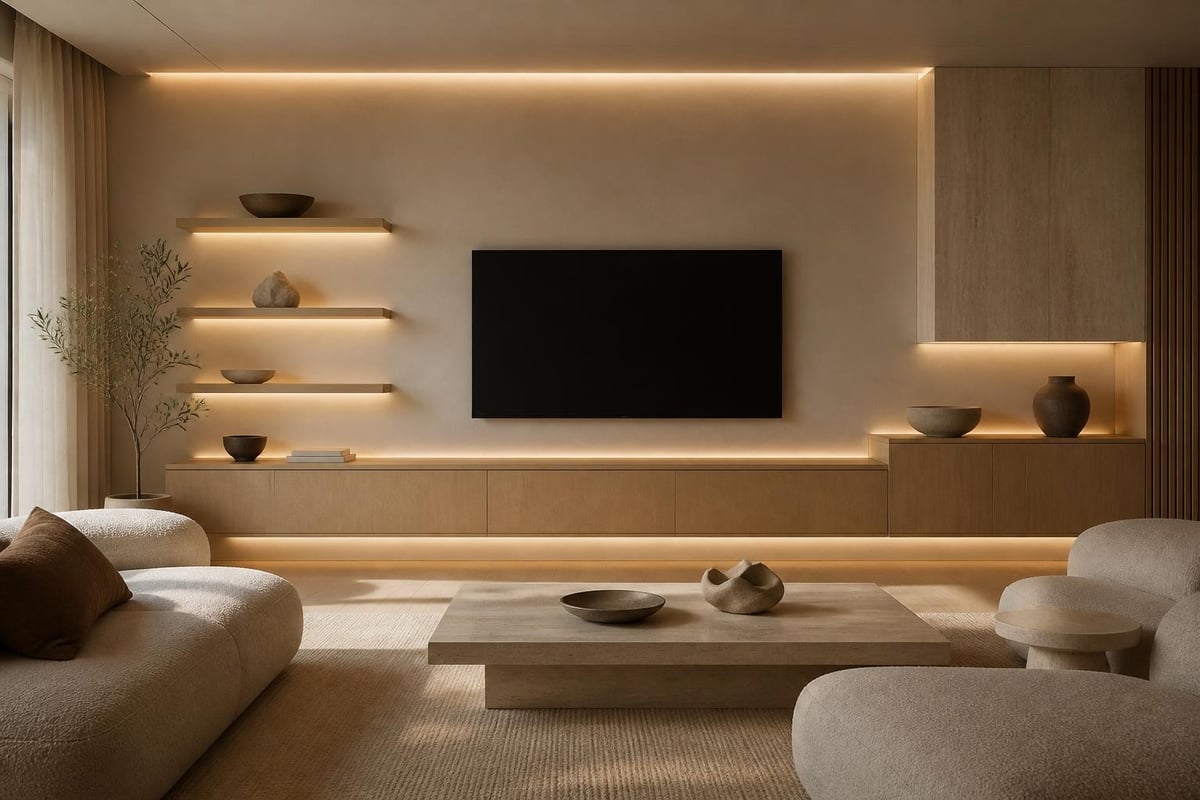
LED strip lighting tucked under shelves or along the top edge highlights objects and adds ambient light. Most strips run on 12V DC via a plug-in transformer. Adhesive-backed strips peel and stick to the underside of shelves; aluminium channels provide a cleaner finish and better heat dissipation.
Colour temperature matters. Warm white (2,700–3,000K) suits timber finishes and living rooms. Cool white (4,000–5,000K) works in kitchens and offices but feels clinical next to oak or walnut. Dimmable drivers let you adjust brightness without changing bulbs.
Some units ship with built-in USB charging ports in the drawer fronts or side panels. They're convenient for tablets and phones but require a mains connection inside the cabinet. Check the power rating-cheap ports deliver 1A, which charges slowly. Look for 2.4A per port.
Wall-Mounted Versus Freestanding Units
Wall-mounted units float the cabinet off the floor, making cleaning easier and creating visual space. They require solid fixing into studs or concrete, not just plasterboard. A 40 kg unit plus a 20 kg screen demands two studs minimum, with coach screws or toggle bolts rated to the combined load.
Freestanding units sit on legs or a plinth. Legs lift the cabinet 100 to 200 mm, allowing a robot vacuum to pass underneath. Plinths (solid base panels) rest directly on the floor and create a heavier, grounded look. Neither is better-it depends whether you prioritise clean lines or easy cable access.
| Mounting Style | Floor Clearance | Installation Complexity | Visual Weight |
|---|---|---|---|
| Wall-mounted | Full | High (stud fixing) | Light |
| Legged | 100–200 mm | Low (freestanding) | Medium |
| Plinth base | 0 mm | Low (freestanding) | Heavy |
Floating units work best on concrete or timber-framed walls where you can locate studs accurately. Plasterboard-only walls need reinforcement or a different approach.
##配置 for Different Room Layouts
Corner units wrap two walls, turning dead space into storage. They suit small living rooms where a straight run would block doorways or windows. Angled corners (45° face) display the screen to two seating areas; square corners (90° join) maximise shelf count.
Long, low units (2,400 mm or more) anchor open-plan spaces and work as room dividers when placed perpendicular to the wall. They need structural support at the centre to prevent sagging-either a leg or an internal vertical panel.
Pairing with Sofas and Occasional Tables
Your tv unit nz choice should balance with your sofa's scale. A deep, three-seat sofa (900 mm deep, 2,200 mm wide) pairs well with a low, wide unit in matching timber or complementary tones. A compact two-seater looks lost beside a 2,400 mm console; a 1,600 mm unit keeps proportions tight.
Coffee tables and side tables create visual rhythm. If your unit has oak veneer and black metal legs, repeat that palette in your occasional tables to tie the room together without exact matching.
Safety and Stability
Tip-over accidents happen when children climb open drawers or cabinets rock forward under uneven weight. Anchor freestanding units taller than 800 mm to the wall with a furniture strap or L-bracket. The bracket screws into the cabinet back and a wall stud, limiting forward tilt.
Product safety guidance from the New Zealand government addresses foam-filled furniture but the stability principles apply to any freestanding storage. Distribute weight evenly-heavy components on lower shelves, light items up top.
Drawers should have stops that prevent full extraction. Pull the drawer all the way out; if it lifts free without resistance, it lacks a stop. That's a red flag in homes with young children.
Choosing Between Local and Imported Units
New Zealand-made units typically use local or Australian panels, with final assembly in Auckland or Christchurch workshops. Lead times run two to six weeks. Imported units ship as flat-pack from Europe or Asia, arriving in 8 to 16 weeks depending on freight schedules.
Local production allows custom sizing and finish matching. You specify the width to the nearest 50 mm, choose hardware and adjust internal layouts. Imported stock comes in fixed configurations-what you see is what you get. The trade-off is price. Local custom work costs 30 to 50 per cent more than an imported equivalent but fits awkward spaces perfectly.
Check warranty terms. Local makers often provide five-year structural guarantees and will repair or replace faulty components. Imported flat-pack warranties cover 12 months, and replacement parts ship from offshore warehouses.
Fire Safety and Material Choices
Fire and Emergency New Zealand research on building contents examines how furniture materials combust and what toxins they release. Timber and MDF burn slower than polyurethane foam but still contribute to fire load. Flame retardants reduce ignition risk but can release harmful gases during combustion.
For TV units, the main concern is cable management and heat from electronics. Keeping cables tidy and ensuring ventilation lowers fire risk more than material choice. Avoid running power cables under rugs or bundling them tightly behind closed panels.
If your unit includes upholstered drawer fronts or fabric-backed doors, check that foams meet New Zealand's product safety standards for foam-filled furniture. Polyurethane foams must pass ignitability tests to reduce household fire hazards.
Budgeting and Value Retention
Entry-level tv unit nz options start near $400 for a laminate flat-pack with basic drawer runners and cam-lock assembly. Mid-range veneer units with soft-close drawers and adjustable shelves sit between $1,200 and $2,500. Custom solid-timber or designer-label pieces exceed $4,000.
Higher spend buys better joinery, thicker veneer, metal drawer boxes and local timber species. Resale value holds when construction quality is visible-dovetail drawers, hand-matched veneer grain and branded hardware (Blum, Hettich) all signal longevity.
Flat-pack units depreciate faster. After five years, a $600 laminate console resells for $100 to $150. A $2,000 oak veneer unit with quality fittings will fetch $800 to $1,000 if kept in good condition.
Timing Your Purchase
Furniture retailers run clearance sales in January and July, discounting floor stock and discontinued lines by 20 to 40 per cent. New-season collections arrive in March and September, making February and August the best months to negotiate on outgoing models.
Custom orders placed during sale periods rarely attract discounts-you're paying for made-to-order work, not stock clearance. If you need specific dimensions, budget full price and plan lead time around your move or renovation schedule.
A well-chosen TV unit balances screen size, seating height and storage in a package built to last. Measure twice, specify materials that suit your household use and anchor freestanding pieces for safety. At Bauhaus, our Auckland showrooms stock contemporary units in oak, walnut and matte finishes, and our team can walk you through proportions, joinery and custom sizing. Visit us to see construction details firsthand and find a piece that works with your space.