When you're outfitting a bedroom, the furniture you choose sets the tone for how the room functions and how well you sleep. Bedroom designer furniture extends beyond the bed itself to include bedside tables, occasional chairs, benches, and storage that support daily rituals, from morning routines to late-night reading. In 2026, homeowners across New Zealand increasingly look for pieces that combine durable construction, considered proportions, and materials that stand up to years of use without sacrificing visual restraint. The right furniture makes a bedroom work harder while feeling calmer.
What Defines Bedroom Designer Furniture
Bedroom designer furniture distinguishes itself through materials, joinery, and proportion. It's built using solid timber, quality veneers, steel frames, and upholstery-grade fabrics, not particle board or thin laminates. Joints are mortise-and-tenon or dowelled, drawers run on metal extension slides, and finishes resist daily handling. Dimensions suit the way people actually use a bedside table or chair: drawer depths accommodate books and devices, seat heights match bed edges, table tops sit level with mattress height for easy reach.
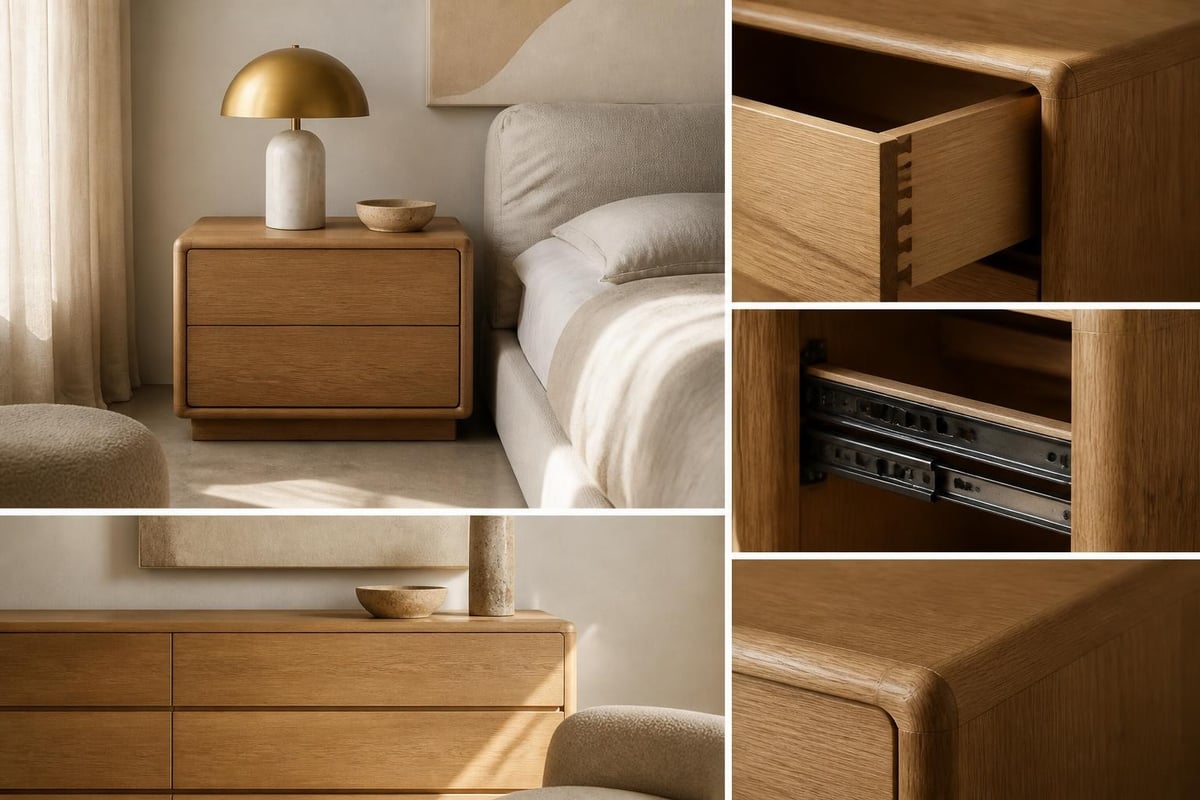
The design itself avoids ornament. Clean lines, simple silhouettes and neutral tones suit rooms where visual calm matters more than statement-making. Contemporary bedroom designer furniture prioritises function over decoration, with each piece earning its place through utility and craftsmanship.
Material Choices and Indoor Air Quality
Materials matter, particularly in a room where you spend eight hours a night. Low-VOC finishes, solid timber, natural upholstery fibres, and water-based lacquers reduce off-gassing. Formaldehyde emissions from composite wood products are regulated in many markets, but choosing furniture made from solid wood or FSC-certified materials sidesteps the issue entirely. The Forest Stewardship Council provides guidance on certified furniture, useful when sourcing bedroom pieces for a new build or renovation.
Upholstered seating in bedrooms benefits from breathable fabrics. Canvas, wool, and linen allow air circulation, reducing moisture build-up. Foam cushions should use high-resilient, CFC-free foam. Leather and eco-leather wipe clean, suited to homes with pets or young children. Each material ages differently: solid timber develops patina, steel powder-coat resists chips, and quality upholstery holds its shape without sagging.
Bedside Tables and Nightstands
Bedside tables anchor the bedroom layout. They need to sit at mattress height or slightly below, typically 50-65cm depending on bed frame and mattress depth. A drawer provides concealed storage for chargers, medication, and personal items. An open shelf below suits books or baskets.
| Feature | Specification | Purpose |
|---|---|---|
| Height | 50-65cm | Aligns with mattress top for easy reach |
| Drawer depth | 10-15cm | Fits devices, glasses, small books |
| Surface width | 35-50cm | Holds lamp, water glass, phone |
| Open shelf | Optional | Extra storage without drawer cost |
Solid timber bedside tables use dovetail or finger-jointed drawers with metal extension slides for smooth, quiet operation. Veneered MDF and plywood reduce cost while maintaining visual consistency if the veneer matches solid timber legs or frame. Avoid particle board in drawers; it sags under weight and splits at screw holes.
The Max Bedside Table with 2 Drawers uses solid oak with a natural oil finish, offering two drawers on metal slides and a compact 40cm width. The Enzo Side Table with Drawer combines walnut veneer with a steel frame and powder-coated legs, suited to rooms where mixed materials add visual interest.
Single Drawer Versus Double Drawer
Single-drawer bedside tables keep the form minimal. They work in tight spaces, beside platform beds, or where a lamp and small surface suffice. Double-drawer designs offer twice the storage without increasing footprint. The second drawer typically holds less-used items: spare bedding, notebooks, or seasonal accessories.
Open-shelf models, such as the Max Bedside Table with Open Shelf, suit readers who stack books or prefer baskets for loose items. The open construction reduces visual weight, useful in smaller bedrooms where closed drawers feel heavy.
Occasional Seating for Bedrooms
A chair or bench in the bedroom serves multiple roles: a place to sit while dressing, to drape tomorrow's clothes, or to read before bed. Armchairs need low backs or open arms to avoid blocking sightlines. Benches fit the foot of the bed or along a wall.
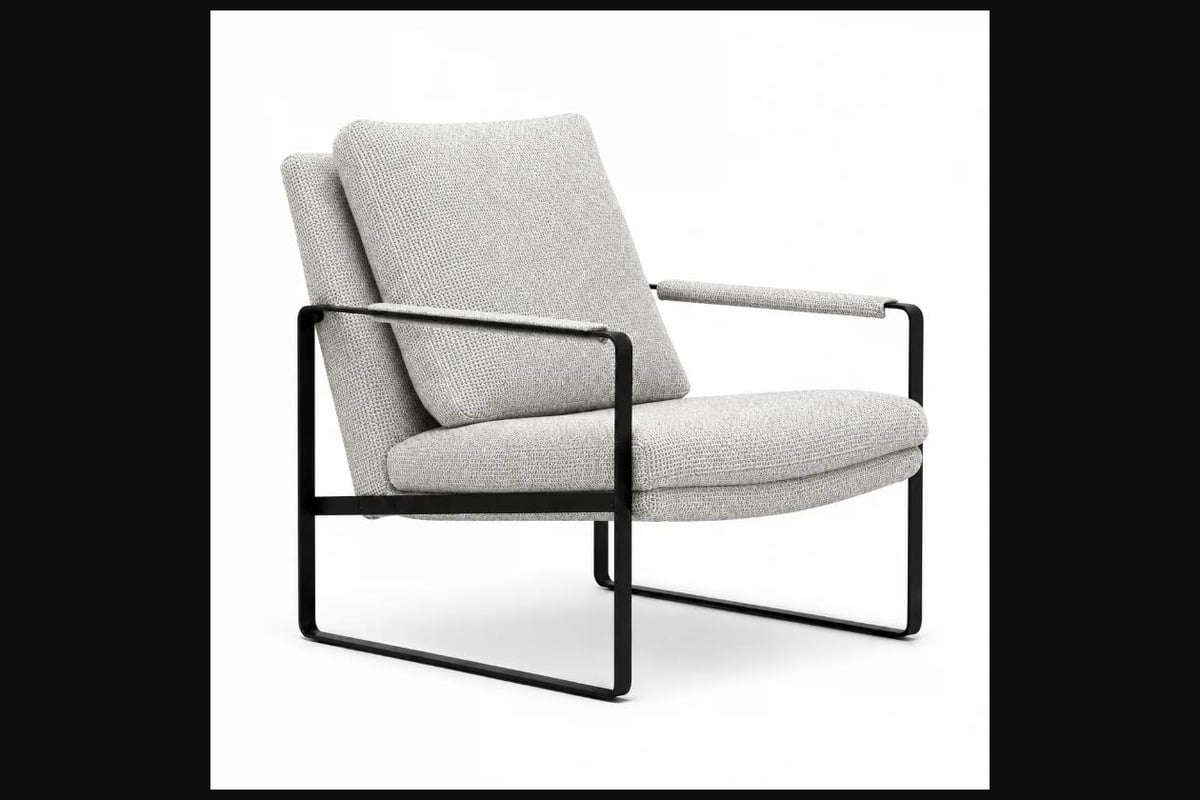
The Leman Armchair measures 70cm wide and 86cm deep, with a webbed steel seat frame and polyurethane foam core wrapped in polyester fibre, delivering a genuine lean-back sit rather than an upright perch. Fitted fabric covers need only regular vacuuming, while the feather-down throw cushion wants an occasional shake. Available in canvas and mineral grey or other fabrics and leathers, the chair suits bedrooms where occasional seating doubles as reading or relaxation space without encroaching on floor area.
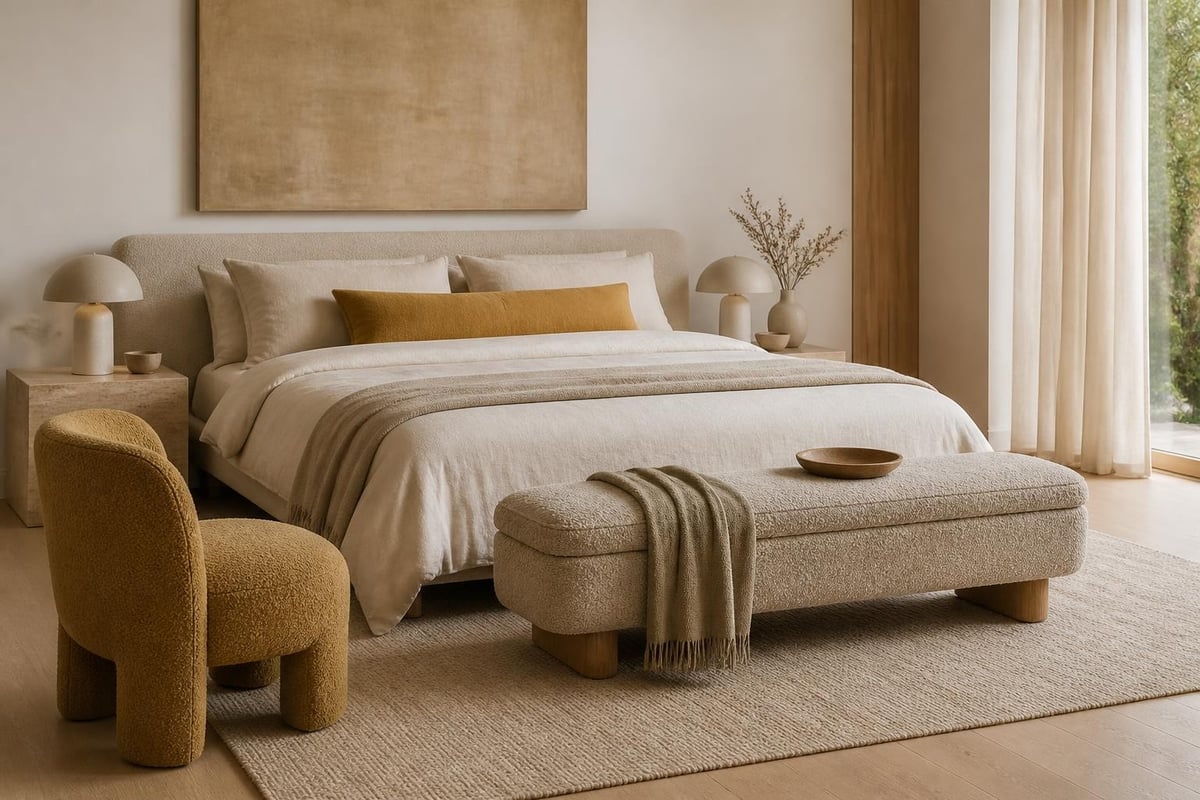
Swivel chairs offer flexibility. The Cove Armchair rotates 360 degrees on a concealed base, turning to face the bed, window, or dressing area without rearranging furniture. The barrel back wraps into the arms in one upholstered curve, generous seating for its footprint.
Benches at the bed's foot provide a landing zone for folded clothes, bags, or extra blankets. The Crescent Bedroom Bench Seat uses upholstered foam on a timber or steel frame, low profile to preserve sightlines and fit under higher bed frames.
Sizing Chairs and Benches to the Room
Measure your bedroom before adding seating. A chair needs at least 60cm clearance in front for comfortable entry and exit. Benches should not exceed bed width minus 20cm on each side, maintaining symmetry and circulation. In a 3.5-metre-wide bedroom, a 180cm bench fits a queen bed while leaving walkable space.
Avoid placing chairs directly in traffic paths between wardrobe and door. Corners, window alcoves, or the side wall opposite the bed work better. If the room is under 12m², skip the armchair and use a bench; it stores vertically against the wall when not in use.
Storage Beyond the Bedside
Bedroom storage extends to chests of drawers, low sideboards, and consoles that hold folded clothing, accessories, and linens. Bedroom designer furniture in this category uses the same construction as bedside tables: solid timber frames, metal drawer slides, and soft-close hinges.
The Max Chest of 4 Drawers stacks four deep drawers in a narrow footprint, suited to walls beside windows or in alcoves. Each drawer uses metal extension slides for full access. The Max Sideboard 4 Door offers concealed storage with adjustable internal shelves, better for bulkier items like spare duvets or out-of-season clothing.
- Chest of drawers: Vertical stacking, narrow footprint, suited to tight walls
- Low sideboard: Horizontal format, can double as TV unit or display surface
- Console table: Slim depth (30-40cm), fits behind bed or along short wall
- Modular storage: Stacked units like the Stacked Podium 2.0, customisable by adding modules
Consoles work well behind a bed in larger rooms, offering surface space for lamps, books, or decorative objects without the depth of a sideboard. The Enzo Console combines walnut veneer with steel legs, 120cm wide and 35cm deep, fitting narrow gaps without blocking circulation.
Internal Organisation
Well-designed bedroom storage includes adjustable shelves, removable drawer dividers, and sufficient depth. A drawer for folded jumpers needs at least 12cm internal height; shirt drawers can be shallower at 8-10cm. Dividers keep socks, belts, and accessories separated. Soft-close drawer slides reduce noise, particularly useful in shared bedrooms or homes with light sleepers.
Lighting and Bedside Lamps
Bedside lighting should deliver enough light for reading without flooding the room. Task lamps with adjustable arms or directional shades focus light on the page or screen. Ambient lighting, whether pendant or wall-mounted, sets the room's overall tone.
The International WELL Building Institute's Light standard recommends limiting blue-spectrum light in the evening to support circadian rhythms. Warm-white bulbs (2700-3000K) suit bedrooms. Dimmers allow adjustment for different tasks: bright for dressing, low for winding down.
Table lamps need stable bases to resist tipping when reaching for the switch. Weighted ceramic, turned timber, or metal bases work best. Cord length should reach the nearest outlet without excess slack pooling on the floor.
Pendant and Wall Lighting
Pendants hung beside the bed free up bedside table space. Mount them 60-80cm above the mattress, aligned with the table edge. Wall-mounted swing-arm lamps, such as articulated reading lights, adjust to direct light exactly where needed. They require early planning to run wiring through the wall during construction or renovation.
Integrating Bedroom Furniture with Mattress and Bed Frame
The bed frame anchors the bedroom furniture layout. Platform beds with integrated side tables reduce furniture count. Upholstered headboards add softness but require regular vacuuming to prevent dust build-up. Timber frames suit rooms with mixed-material furniture, matching bedside tables and storage pieces.
Choosing a mattress that supports sleep quality affects how you use the bedroom. A higher mattress (30-35cm including base) requires taller bedside tables; a lower Japanese-style platform bed suits shorter tables or floor cushions. Measure total bed height, mattress plus base, before selecting tables.
The National Sleep Foundation recommends maintaining clear circulation around the bed, at least 60cm on each side. This clearance ensures you can walk, open drawers, and access storage without obstruction. In tight rooms, place the bed against one wall to maximise usable floor space.
Layout and Proportion in the Bedroom
Bedroom layouts start with bed placement. Centre the bed on the longest wall unless windows, doors, or built-in wardrobes dictate otherwise. Flanking bedside tables create symmetry, particularly in double or queen beds. King beds can take wider or taller tables without appearing undersized.
| Room Dimension | Bed Size | Bedside Table Width | Suitable Seating |
|---|---|---|---|
| 3m × 3.5m | Double/Queen | 35-45cm | Bench only |
| 3.5m × 4m | Queen/King | 40-50cm | Small armchair or bench |
| 4m × 5m | King | 45-55cm | Armchair + bench |
Leave at least 80cm between furniture and walls for drawer access and comfortable movement. Measure open drawer depth: a 40cm-deep drawer needs 45-50cm clearance when fully extended.
Asymmetric Layouts
Not all bedrooms suit symmetry. In rooms with off-centre windows, built-in robes on one side, or angled walls, asymmetric layouts work better. Place a single bedside table on the most-used side, a chair or bench on the other. Or use a tall narrow bedside on one side, a low wide table on the other, balancing visual weight without matching forms.
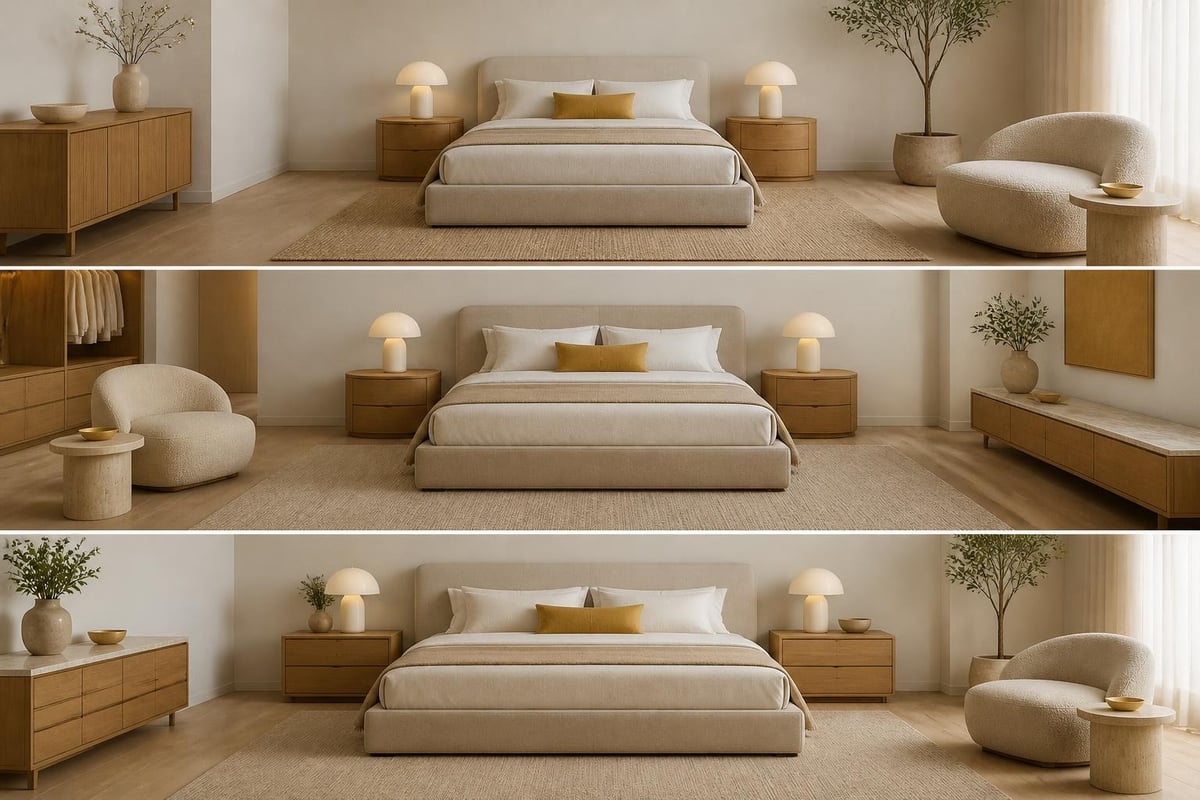
Asymmetry suits contemporary interiors where visual rhythm trumps mirror-image matching. A timber bedside table on the left, a steel-and-glass side table on the right, can unify through colour or height rather than identical form.
Bedroom Furniture Trends in 2026
Current bedroom design trends emphasise warm neutrals, textured upholstery, and mixed materials. Bouclé fabrics, turned timber legs, and curved silhouettes appear across chairs, benches, and bed frames. Colour palettes lean toward sand, terracotta, soft grey, and muted green, moving away from stark white-and-black minimalism.
Lower bed frames, often 25-30cm total height, dominate new builds and renovations. They open up vertical space, making ceilings feel higher. Matching furniture in walnut, oak, or ash creates cohesion without strict sets. Wall treatment ideas and furniture arrangements show how panelling, paint, and textiles interact with furniture profiles.
Sustainability continues to influence material choice. Solid timber from certified forests, low-VOC finishes, and locally made furniture reduce environmental impact. New Zealand buyers increasingly ask about timber origin, finish type, and product lifespan when selecting bedroom designer furniture.
Avoiding Fast-Fashion Furniture
Bedroom furniture represents a multi-year investment. Avoid trends that date quickly: overly ornate headboards, mirrored surfaces, or high-gloss finishes lose appeal within a few seasons. Instead, choose neutral tones, natural materials, and classic proportions that adapt as tastes shift. You can update soft furnishings, paint, and lighting more easily than replacing a timber chest of drawers.
Quality construction outlasts trends. A solid oak bedside table with dovetail drawers remains functional and attractive for decades. Replacing drawer pulls or refinishing the top extends its life further.
Choosing Bedroom Designer Furniture for New Zealand Homes
New Zealand homes vary widely in size, age, and layout. Villas and bungalows feature high ceilings and large rooms; modern townhouses pack bedrooms into compact footprints. Furniture must adapt to these differences.
In older homes with ornate cornices and picture rails, contemporary bedroom furniture provides visual contrast. Clean-lined bedside tables and simple upholstered chairs let architectural details stand out. In new builds with flush doors and minimal trim, furniture carries more design weight. Textured fabrics, turned legs, and mixed materials add interest without architectural support.
Coastal homes benefit from light-coloured timbers, woven textures, and easy-clean upholstery. Inland and alpine regions suit darker woods, wool fabrics, and robust construction that handles dry indoor air and temperature swings.
Shipping, Assembly, and Delivery
Bedroom furniture often ships flat-packed to reduce cost and simplify delivery through narrow hallways and staircases. Assembly requires basic tools: a drill-driver, Allen keys, and a level. Instructions should be clear, with numbered parts and step-by-step diagrams. Pre-drilled holes and dowelled joints speed assembly and ensure alignment.
Fully assembled furniture, such as solid timber chests or upholstered chairs, needs careful measurement before purchase. Doorways, stairwells, and hallway turns must accommodate the largest dimension. In apartments or upstairs bedrooms, confirm delivery access before ordering.
Maintaining Bedroom Designer Furniture
Solid timber furniture needs regular dusting and occasional oiling. Oil finishes, common on oak and walnut, deepen colour and protect against moisture. Apply oil every 12-24 months depending on humidity and use. Lacquered or varnished surfaces need only wiping with a damp cloth; avoid harsh cleaners that strip the finish.
Upholstered seating requires weekly vacuuming to remove dust and prevent fabric abrasion. Feather-down cushions need plumping to redistribute fill. Leather and eco-leather wipe clean with a damp cloth; condition genuine leather every six months to prevent drying and cracking.
Metal frames and powder-coated legs resist rust and corrosion in New Zealand's humid climate. Wipe with a dry cloth to remove dust. Scratches in powder-coat can be touched up with matching paint if needed.
Repair and Refinishing
Quality bedroom designer furniture supports repair. Drawer slides can be replaced, drawer fronts refinished, and upholstery recovered. A solid timber bedside table damaged by water rings or scratches can be sanded and re-oiled. This longevity justifies higher upfront cost compared to furniture that must be discarded when damaged.
Keep assembly instructions and spare parts. Drawer handles, knobs, and slides wear over time. Ordering replacements from the original manufacturer ensures fit and finish match.
Selecting Bedroom Furniture for Different Sleepers
Bedroom furniture needs vary by household. A couple sharing a bedroom prioritises two bedside tables, symmetrical layout, and sufficient storage for both. A single adult may prefer one table, a desk, and a reading chair. Guest bedrooms need flexible furniture: a bench that doubles as luggage rack, a bedside table with drawer space for visitor essentials.
Children's bedrooms benefit from durable, easy-clean furniture. Rounded edges reduce injury risk. Storage should be accessible: low drawers, open shelves, and benches with lift-top compartments. As children grow, furniture adapts: a small bedside table becomes a desk side table, a low bench moves to the entryway.
Elderly or mobility-limited users need furniture that supports independence. Higher bed frames (45-50cm) ease standing. Bedside tables with large handles and smooth-running drawers reduce effort. Chairs with arms provide support when rising.
Multi-Generational Homes
In multi-generational households, bedroom furniture must suit different needs within one home. Bedside tables with cable management keep devices charged without visible cords. Dimmable lighting accommodates different sleep schedules. Storage with locks or closed compartments offers privacy.
Consistency across bedrooms unifies the home visually while allowing individual expression. Use the same timber finish or colour palette, varying table styles or upholstery to distinguish each room.
Building a Cohesive Bedroom Furniture Collection
Bedroom designer furniture works best as a cohesive collection, not random pieces. Start with bedside tables that match in height, material, or colour. Add a chair or bench in complementary upholstery. Choose storage pieces from the same family or finish.
At Bauhaus, contemporary furniture sets demonstrate how mixing timber, steel, and upholstery within a unified colour palette creates visual rhythm. An oak bedside table pairs with a steel-framed armchair in neutral linen, both grounded by a wool rug in soft grey.
Mixing styles works when proportions align. A mid-century modern bedside table can sit beside a contemporary platform bed if both share low profiles and clean lines. Avoid combining ornate traditional pieces with stark minimalist furniture; the contrast feels jarring rather than intentional.
Colour and Finish Coordination
Timber finishes range from light ash to deep walnut. Within a bedroom, keep timber tones within one spectrum: warm (oak, walnut, teak) or cool (ash, beech, whitewashed). Metal finishes, powder-coat black, brushed brass, or matte steel, should repeat across furniture, lighting, and hardware.
Upholstery fabrics unify mixed furniture. A linen armchair, wool throw, and cotton bedding in tonal greys or beiges tie together different materials and forms. Avoid matching everything exactly; variation in texture and shade adds depth.
Working with Interior Designers and Developers
Interior designers and developers sourcing bedroom designer furniture for multiple units, display homes, or high-end residential projects need reliable supply, consistent quality, and flexible lead times. Bauhaus works with designers and developers to specify furniture for new builds, renovations, and staged properties, offering trade pricing, delivery coordination, and custom fabric and finish options.
Designers benefit from seeing and sitting on furniture in person. Bauhaus operates two Auckland showrooms where clients and designers can test chairs, measure bedside tables, and compare timber samples. Samples and fabric swatches are available for client presentations and material boards.
For developers furnishing multiple bedrooms in a new apartment building or retirement village, bulk orders and staged delivery ensure furniture arrives when needed. Consistent lead times and quality control prevent delays and mismatches.
Disclaimer: AI-supported images may differ from products on website.
Bedroom designer furniture combines durable materials, thoughtful joinery, and proportions suited to how you actually live. From bedside tables with metal extension slides to occasional seating that doubles as reading chairs, each piece earns its place through function and restraint. At Bauhaus, we specialise in contemporary furniture that suits New Zealand homes, from villas to modern apartments, offering solid timber, quality upholstery, and personalised service to help you find pieces that feel right at home. Visit our Auckland showrooms to see the range, test the chairs, and talk through your bedroom furniture needs with our experienced team.